
Price Differences Among Different Types of Oil-Free Air Compressors
In industrial production, air compressors serve as critical power equipment, and their selection is directly related to production efficiency and product quality. With the rising demand for clean air across industries, the application scope of oil-free air compressors has been continuously expanding. However, different application scenarios impose distinct requirements on the technical parameters, materials, and certifications of air compressors, which are directly reflected in their pricing. Understanding the price ranges of various types of air compressors helps enterprises make rational procurement decisions based on their actual needs.
First of all, oil-lubricated air compressors, which are widely used in general industrial scenarios, are relatively affordable due to their mature structure and low maintenance costs. Taking the commonly used 7.5kW to 30kW screw-type oil-lubricated air compressors as an example, their market prices usually range from 10,000 yuan to 40,000 yuan. Such equipment is suitable for occasions with low air quality requirements, such as general machining and construction projects. Nevertheless, the compressed air discharged contains trace amounts of oil, failing to meet high cleanliness standards.
In contrast, industries with stringent air quality requirements, such as food, pharmaceuticals, and electronics, must adopt oil-free air compressors. These devices ensure completely oil-free compressed air through special designs (e.g., water lubrication, dry screw, or scroll technologies) and usually need to obtain the ISO 8573-1 Class 0 oil-free certification. Taking a 22kW oil-free screw air compressor as an example, its market price generally ranges from 80,000 yuan to 150,000 yuan, which is approximately 2 to 3 times the price of an oil-lubricated model with the same power. If higher cleanliness levels or special explosion-proof requirements are involved, the price will increase further.
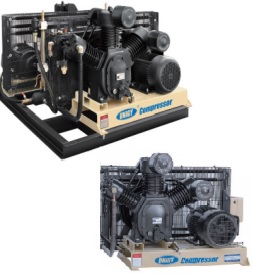
When applications require higher pressure output, the price of air compressors will also change accordingly. For instance, in certain chemical, laser cutting, or high-pressure testing scenarios, the system requires a discharge pressure of up to 10MPa or even higher. Most of these high-pressure air compressors adopt piston-type or multi-stage compression structures, featuring complex manufacturing processes and high material strength requirements. A 10MPa, 15kW high-pressure oil-lubricated air compressor is usually priced between 60,000 yuan and 120,000 yuan, with the specific price depending on the brand, cooling method, and level of automation.
If both "high pressure" and "oil-free" requirements are met simultaneously, the equipment cost will rise significantly. A typical example is the bottle-blowing air compressor used for PET bottle blow molding. Such equipment not only needs to provide stable high pressure of over 10MPa but also must ensure absolutely oil-free compressed air to avoid contaminating food packaging materials. To achieve this goal, manufacturers often adopt multi-stage oil-free compression, high-efficiency cooling systems, and precision filtration devices. A 15kW oil-free high-pressure air compressor suitable for small and medium-sized bottle-blowing production lines is usually quoted between 200,000 yuan and 350,000 yuan on the market, and some high-end imported brands cost even more. In addition, such equipment also has higher standards for energy efficiency, noise control, and operational stability, further driving up the overall cost.
It is worth noting that besides the price of the main unit, users should also consider the cost of supporting equipment (such as dryers, air storage tanks, and filters), installation and commissioning fees, as well as long-term maintenance costs. Especially for oil-free high-pressure models, the replacement cycle of special accessories is short and the technical service requirements are high, so the long-term use cost cannot be ignored.
The differentiated demands of different industries for compressed air quality, pressure, and reliability determine the diversity of technical routes and pricing strategies for air compressor products. When selecting equipment, enterprises should comprehensively evaluate their working conditions, compliance requirements, and full-life cycle costs, rather than focusing solely on the initial procurement price.