
Application and Technical Considerations of Natural Gas Compressors in Underground Gas Storage Injection and Withdrawal Operations
Underground gas storage (UGS) facilities serve as a cornerstone of natural gas peak-shaving and supply security, and their operational efficiency heavily depends on supporting compression systems. During the injection phase, natural gas from main pipelines must be pressurized before being injected into underground reservoirs; during withdrawal, low-pressure gas extracted from the formation must be recompressed to meet pipeline delivery requirements. Throughout this cycle, natural gas compressors perform critical energy conversion functions, with their performance directly influencing the injection/withdrawal capacity and economic viability of the storage facility.
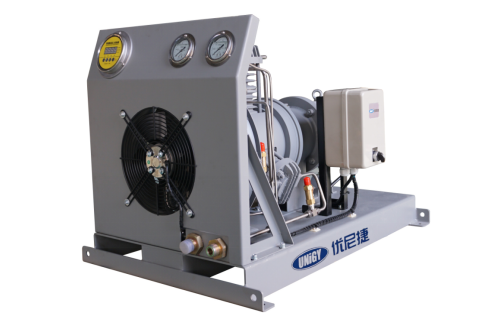
Unlike the steady-state operation typical in long-haul pipelines, natural gas compressors used in UGS often face frequent starts/stops, wide load variations, and broad pressure ranges. For example, during peak injection periods, compressors may need to rapidly pressurize large volumes of gas to over 20 MPa for injection into salt caverns or depleted reservoirs. Conversely, during off-peak withdrawal, inlet pressures might drop below 1 MPa, requiring significant compression to reach pipeline acceptance levels. This wide operating envelope places higher demands on natural gas compressor design.
In practice, UGS projects commonly adopt multi-stage compression configurations integrated with anti-surge control systems to accommodate varying operational phases. Some large-scale facilities even deploy multiple compressor types—reciprocating units for high-pressure injection and centrifugal units for high-volume withdrawal—enabling flexible switching to achieve optimal operational strategies. Additionally, to address seasonal load differences, some sites incorporate standby units or mobile compressor skids to enhance system flexibility.
Reliable operation of natural gas compressors in UGS also involves intricate process integration. For instance, hot compressed gas must be cooled and separated before underground injection, while produced gas during withdrawal may carry moisture or impurities requiring pre-filtration to protect internal compressor components. Consequently, compressor systems are tightly integrated with dehydration, metering, and emergency shutdown units to form a complete injection/withdrawal process chain.
From a maintenance standpoint, service intervals for UGS natural gas compressors are closely tied to their intermittent operating patterns. Due to non-continuous use, equipment is more susceptible to issues like moisture ingress, corrosion, or inadequate lubrication. Technical personnel must implement targeted maintenance plans—including periodic turning, seal inspections, and control system calibrations—to ensure rapid readiness during critical periods.
In recent years, digitalization has enabled many UGS facilities to deploy IoT-based compressor monitoring platforms that collect real-time operational data for performance and efficiency analysis. This not only enhances operational transparency of natural gas compressors but also supports optimized injection/withdrawal scheduling. As seasonal balancing and emergency response demands grow, efficient, adaptable, and intelligent natural gas compressor systems will play an increasingly prominent role in regional energy security.