
The Critical Role and Operational Management of Natural Gas Compressors in Long-Distance Pipeline Systems
In modern energy transmission infrastructure, natural gas—recognized as a clean and efficient fossil fuel—relies on extensive and complex pipeline networks for delivery. Within this system, natural gas compressors play an indispensable role. These compressors are primarily used to increase gas pressure, overcoming frictional resistance along the pipeline and ensuring stable, continuous delivery from production fields to end users. Especially over long distances, pressure gradually declines due to friction losses and elevation changes, necessitating multiple compressor stations equipped with several natural gas compressors operating in coordination.
From an engineering perspective, selecting the appropriate natural gas compressor involves evaluating multiple factors, including flow rate, inlet and outlet pressures, gas composition, and environmental conditions. Currently, the two dominant types are reciprocating and centrifugal compressors. Reciprocating compressors are better suited for high-pressure, low-flow applications, while centrifugal compressors excel in high-flow, medium-to-low-pressure scenarios. In practice, operators dynamically adjust compressor loads based on real-time pipeline scheduling instructions to match demand fluctuations while balancing energy efficiency and equipment longevity.
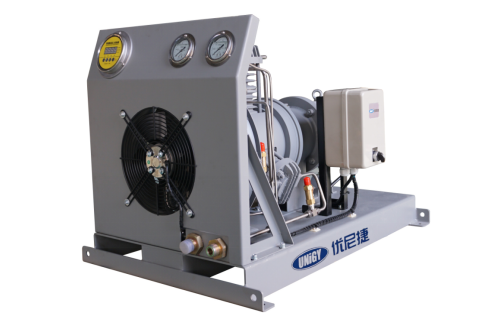
The reliability of a natural gas compressor directly impacts the safety and economics of the entire transmission system. A failure or unplanned shutdown can disrupt local supply and potentially trigger cascading effects downstream. Therefore, professional maintenance teams typically employ condition monitoring and predictive maintenance strategies—such as vibration analysis, temperature tracking, and lubricant testing—to detect early signs of potential issues and avoid unexpected outages.
Moreover, with increasing emphasis on carbon reduction goals, energy efficiency requirements for natural gas compressors have become more stringent. Many new or retrofitted projects now incorporate variable frequency drives, intelligent control systems, and waste heat recovery units to reduce specific energy consumption. For instance, optimizing operating parameters of natural gas compressors at certain compressor stations has achieved 5% to 10% energy savings—a significant benefit given annual transmission volumes that can reach tens of billions of cubic meters.
It is also essential that installation, commissioning, and daily operation of natural gas compressors strictly adhere to relevant industry standards and safety protocols. Operators must undergo specialized training to understand equipment structure, control logic, and emergency response procedures. Particular attention is required during startup and shutdown phases, where close monitoring of stage pressures, temperatures, and seal integrity helps prevent risks such as surge, overpressure, or leakage.
As China’s natural gas consumption continues to grow and the national pipeline network expands, technological upgrades and refined management of natural gas compressors will remain vital to ensuring secure energy supply. Moving forward, intelligent, modular, and low-emission compressor solutions are expected to become mainstream, providing robust support for building an efficient and resilient natural gas transmission infrastructure.